From Signals to Decisions: How Data-Powered Border Security Enables Safer, Faster, Lawful Outcomes

Introduction to Malware Binary Triage (IMBT) Course
Looking to level up your skills? Get 10% off using coupon code: MWNEWS10 for any flavor.
Enroll Now and Save 10%: Coupon Code MWNEWS10
Note: Affiliate link – your enrollment helps support this platform at no extra cost to you.
Border and national security missions are increasingly defined by speed, complexity and accountability. Across U.S. Customs and Border Protection and its operational components, including U.S. Border Patrol, Air and Marine Operations and specialized units such as BORTAC and BORSTAR, the difference between a successful interdiction, a timely rescue or a missed opportunity often comes down to one thing: whether fragmented data can be transformed into timely, actionable intelligence.
Even the operational environment has changed. Border activity now unfolds across vast terrain, complex infrastructure and increasingly dense signal environments. Investigations may involve suspected smuggling networks, repeat crossers, trafficking activity or other illegal operations. They often occur alongside urgent searches for missing or endangered persons. In every case, mission outcomes depend on clarity. You cannot act decisively or defensibly without a coherent operational picture.
This is where modern data fusion, the pairing of sensor-derived observations with governed analytics, becomes foundational to border mission success.
Modern Challenges in Border & National Security Operations
Border security teams are not short on data, however common friction points include:
- Fragmented data across systems and domains
Sensor feeds, investigative databases, case notes and operational reports often live in separate tools that were never designed to work together under real-time conditions. - The handoff gap between intelligence and action
Insights may exist, but if they arrive late, lack context or cannot be operationalized by field teams, their value erodes quickly. - Incomplete situational awareness
Border activity is dynamic. Without correlation across sources, agencies risk chasing isolated signals, missing meaningful patterns or over-committing resources to low-confidence leads. - High governance and oversight requirements
Border missions demand lawful, auditable action. This raises the bar for data provenance, access controls and traceability, especially when advanced analytics or AI are involved. - Multi-mission complexity
The same operational environment may require enforcement, investigation, humanitarian response, search and rescue and officer safety considerations, often at the same time.
The result is predictable: analysts spend valuable time reconciling sources instead of producing insight, while field teams make high-stakes decisions with partial visibility.
Sensors as the Front End of Border Intelligence
Sensors form the first mile of border intelligence. They provide the raw observations that enable detection, validation, prioritization and search planning.
Border-relevant sensing may include:
- Fixed and mobile surveillance systems across key terrain and corridors
- Electro-optical and infrared systems supporting day and night awareness
- Radar and coastal sensors enabling air and maritime domain awareness
- Aerial platforms supporting wide-area observation for Air and Marine Operations (AMO)
- Infrastructure-based data sources, such as License Plate Recognition (LPR), where authorized
- Field observations and operational reporting from agents and operators
Although each source answers a narrow question. The mission advantage emerges when these inputs are correlated, aligned to time and location and interpreted together. This turns isolated observations into context, patterns and actionable leads.
The Role of AI-Powered Data Fusion in Border Intelligence
Modern border operations cannot rely on a single feed or analytic lens. They require fusion, the ability to unify, normalize and correlate data across sensors, systems and operational reporting.
An AI-powered data fusion platform strengthens border missions by:
Creating a unified operational picture
Instead of navigating multiple screens and disconnected tools, analysts and operators gain a shared view that brings together:
- Sensor events and alerts
- Authorized contextual data relevant to persons, vehicles and locations
- Historical activity and investigative context
- Temporal patterns and route behaviors
- Confidence indicators that help prioritize attention
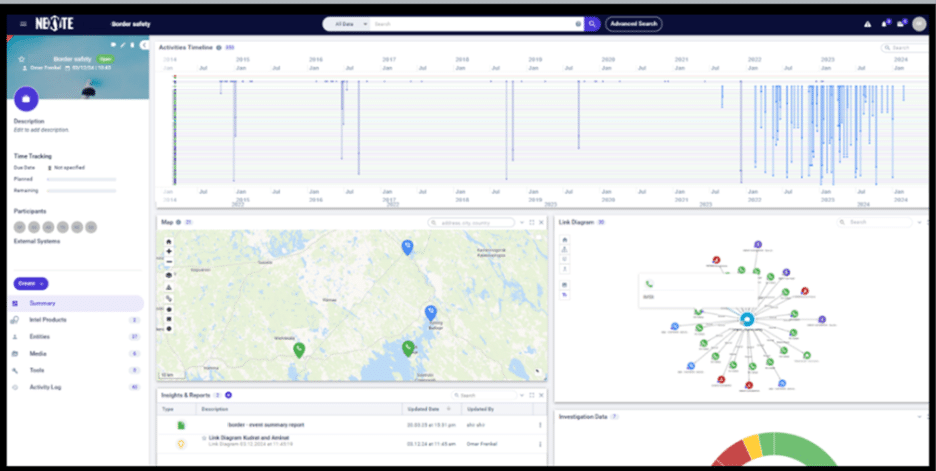 Figure 1: Cognyte provides analysts and operators with a single, shared view that connects data, context and decisions in real time.
 Accelerating the transition from insight to action
Advanced analytics can support:
- Event correlation and de-confliction
- Anomaly detection and pattern recognition over time and geography
- Prioritization of leads based on relevance and risk
- Continuity across shifts, sectors and joint operations
Embedding governance into the workflow
Speed must coexist with accountability. A mission-ready fusion environment supports:
- Role-based access and least-privilege design
- Audit trails linking insights back to source data
- Policy-aligned handling of sensitive information
- Transparent lineage that enables oversight and defensibility
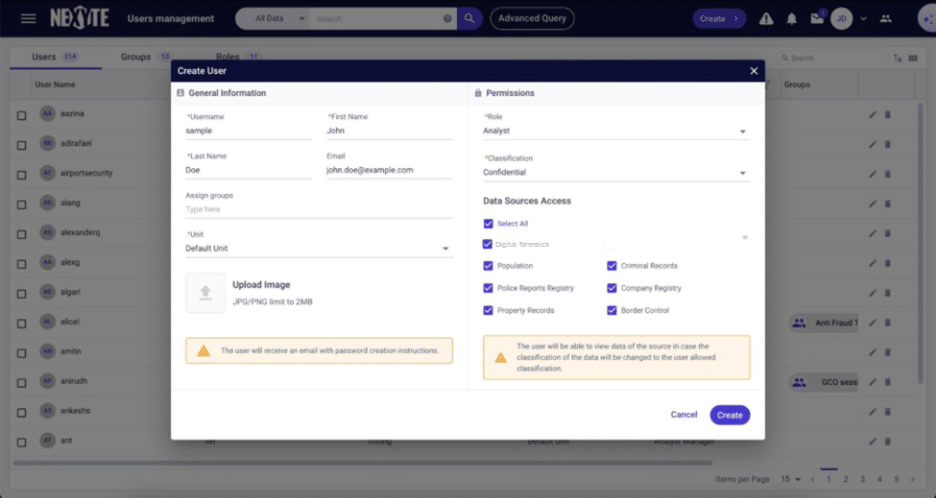 Figure 2: The Cognyte platform enables role-based access, full audit trails, and transparent data lineage keeping sensitive intelligence policy-aligned, accountable and defensible.
 This is how agencies reduce uncertainty without increasing risk.
Enabling the Field: Intelligence that Moves with the Mission
Border security does not succeed in an intelligence center alone. Insight must move across shifts, across units and into the field.
Effective intelligence architectures support analysts in developing context and confidence while enabling agents and operators to act with clarity and safety. Intelligence that arrives without operational relevance becomes latency. Intelligence that cannot be explained or justified becomes a liability.
When intelligence and field operations are connected through a shared framework:
- Analysts generate prioritized, context-rich leads
- Field teams receive actionable direction aligned to policy and mission
- Observations from the field feed back into the intelligence cycle, improving future decisions
This closed loop is essential for both interdiction and search operations.
High-Impact Missions: Interdiction, SAR and Officer Safety
A holistic predictive intelligence-to-action approach supports a range of border security scenarios, including:
- Targeted interdiction of illegal activity
Correlating multi-source indicators helps identify priority subjects, routes, and timing—reducing false positives and improving resource alignment. - Search for missing or endangered persons
Fusing time-based indicators, last-known observations, and sensor events improves search prioritization and accelerates time-to-locate when urgency is critical. - Officer and responder safety
Providing contextual awareness before contact reduces uncertainty and supports safer, more controlled operations. - Operational continuity
Shared intelligence environments preserve case context across shifts and units, reducing duplication and missed handoffs.
Closing the Gaps with a Mission-Ready Intelligence Architecture
A credible border intelligence solution is not a dashboard. It is an operational capability that connects sensing, analytics, governance and field execution.
Key attributes include:
- Multi-source ingestion across sensors and operational systems
- Entity correlation linking people, vehicles, locations and events
- AI-assisted prioritization that highlights what matters most
- Analyst workflows designed for speed and defensibility
- Field enablement that delivers context, not just alerts
- Governance and auditability built into every stage
- Interoperability with existing mission systems
This architecture enables agencies to move from reactive response to sustained decision advantage.
A Practical Way Forward: Intelligence-to-Action, Designed for Border Operations
Border security outcomes increasingly depend on whether agencies can:
- Collect timely observations through sensors and field reporting
- Fuse them into coherent, governed intelligence
- Enable lawful, timely action in the field
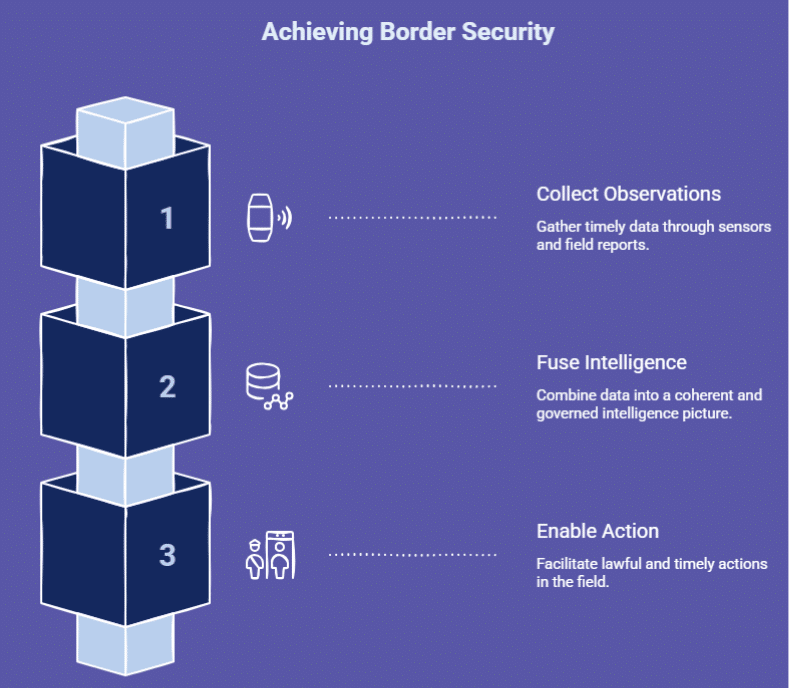
An AI-powered data fusion and decision intelligence platform paired with tools that support search and field operations, helps close the gap between what agencies know and what they can do, responsibly and at operational tempo.
The right starting point is not a feature list, but a mission question:
Where is uncertainty slowing outcomes today, and which data is being used lawfully and defensibly that would reduce it fast enough to matter?
By fusing mission-authorized information, embedding governance and enabling intelligence to move at operational speed, U.S. agencies can shift from reactive perimeter defense to proactive, intelligence-led operations which reduces blind spots, improves coordination and supports decisive, lawful action across land, sea and air.
This is the future of North American border security: from signals to decisions, designed for real-world missions and real-world accountability.
To see our intelligence-to-action framework in practice, book a demo of our specialized operational tools and discover how we help agencies reduce uncertainty and accelerate mission outcomes.
The post From Signals to Decisions: How Data-Powered Border Security Enables Safer, Faster, Lawful Outcomes appeared first on Cognyte.
Article Link: https://www.cognyte.com/blog/border-security-data-fusion/
1 post - 1 participant
Malware Analysis, News and Indicators - Latest topics

Sp123
"An underestimated security threat to organizations is employee apathy and burn out."
