The AI-Embedded SOC: An Operating Model for the Asymmetry Era
Why threat actors are pulling ahead, why SOCs are stalling, and the governance blueprint defenders need to close the gap without losing the plot
“The adversary is iterating on AI weekly, the SOC is iterating on AI quarterly if at all, and that is not a tooling problem, it is an operating model problem.”
The Asymmetry Nobody Wants to Name
Walk into any SOC manager’s office in 2026 and you will hear the same paradox.
On one side of the desk, there is a steady stream of intelligence reports describing how threat actors are using large language models to write polymorphic loaders, generate phishing lures in flawless local dialects, automate reconnaissance against exposed assets, and stitch together end-to-end intrusion campaigns with reasoning agents that adapt mid-engagement.
As of May 2026, those reports are no longer theoretical: Google Threat Intelligence Group (GTIG) has now documented the first confirmed case of a zero-day vulnerability developed with AI assistance, named threat actor groups across four state-sponsored ecosystems experimenting with AI-augmented vulnerability research at scale, and a maturing supply chain attack pattern that targets the AI ecosystem itself.
On the other side of that same desk, there is a team of analysts still copy-pasting log lines into spreadsheets, manually pivoting through five consoles to triage a single alert, and waiting two weeks for a change advisory board to approve a new detection rule.
The vendors selling to this SOC are advertising “AI-powered” everything: AI-powered SIEM, AI-powered EDR, AI-powered SOAR, AI-powered UEBA. And yet the analysts inside the SOC are quietly told not to use ChatGPT, Claude, or any external AI tool with their work data, for very legitimate governance reasons.
The result is the asymmetry we are not naming honestly enough:
Adversaries are operating AI-native, defenders are operating AI-adjacent.
This piece is for the leaders, architects, and senior practitioners who are tired of the binary debate (“AI will replace analysts” versus “AI is too risky to let near production”) and want a serious operating model: one that embeds AI where it earns its place, keeps humans where judgment is non-negotiable, and treats governance not as a brake but as the rail that lets the train move faster.
Inside the AI-Native Kill Chain
Before discussing what defenders should do, we have to be honest about what attackers are already doing. Public threat reporting through 2026 tracks a clear maturation arc, moving from nascent experimentation toward industrial-scale application of generative models within adversarial workflows. Five shifts are now visible in the wild.
Zero-Days Are Now Being Written by AI
This is the headline finding from recent threat intelligence. Investigators identified a Python-based exploit for a two-factor authentication bypass in a widely-used open-source server administration tool, and the artifact carried the unmistakable fingerprints of LLM authorship: a textbook Pythonic structure, extensive docstrings explaining each function, a cleanly-implemented ANSI color helper class, and most damning of all, a hallucinated CVSS score in the code comments. The vulnerability itself was not a memory corruption bug or an injection flaw, it was a high-level semantic logic error where the developer had hardcoded a trust assumption that contradicted the 2FA enforcement logic elsewhere in the codebase.
That last detail matters enormously for detection engineering. Traditional fuzzing and static analysis tools are tuned to find sinks, crashes, and tainted data flows, they are not built to read developer intent and notice when one part of an application contradicts another. Frontier LLMs are uniquely good at exactly this kind of contextual reasoning: they surface dormant logic bugs that look functionally correct to a scanner but are strategically broken from a security perspective.
The implication is structural: the attack surface that was previously invisible to automation is now visible to attackers with API access. Defenders who rely on the historical hardness of “logic flaws are hard to find” are looking at a class of vulnerability whose discovery cost just dropped by an order of magnitude.
Polymorphism at API Speed
Historically, malware authors invested significant time in obfuscation, packing, and variant generation. Today, an attacker can ask a fine-tuned open-weights model to regenerate a loader with different control-flow structure, different string encoding, and different sandbox-evasion tells, on demand, in seconds.
Multiple malware families have now been catalogued that embed this capability directly into their runtime behavior, not just their build process: PROMPTFLUX makes live calls to the Gemini API to dynamically modify itself, HONESTCUE queries Gemini at runtime to request specific VBScript obfuscation routines just-in-time so the bytes on disk at minute zero differ from the bytes at minute thirty. CANFAIL and LONGSTREAM, linked to Russia-nexus operations targeting Ukrainian organizations, take a different approach: they ask an LLM to generate large blocks of plausible-looking but functionally inert code, woven through the malicious logic as camouflage. One LONGSTREAM sample reportedly contained 32 separate instances of code querying the system’s daylight saving status, none of them serving any operational purpose beyond making the malware look like legitimate administrative software to a casual reviewer.
The implication for detection engineering is brutal: signature-grade content has a shorter half-life than your CAB cycle. If your detection lifecycle assumes weeks between idea and production, you are shipping yesterday’s defenses against tomorrow’s variants. Behavioral detection, threat-informed hunting, and infrastructure-anchored indicators are no longer “complement” categories, they are the only categories that scale.
When the Malware Reasons for Itself
The frontier of offensive AI is not just better content generation, it is autonomy. Researchers have now documented a PRC-nexus actor deploying two agentic frameworks against a Japanese technology firm and an East Asian cybersecurity platform. The first is Hexstrike, paired with a temporal knowledge graph called Graphiti that lets the agent maintain persistent state across the attack surface and decide for itself when to pivot between reconnaissance tools. The second is Strix, a multi-agent penetration testing framework that automates vulnerability identification and validation. The human attacker becomes a supervisor of the agent rather than a hands-on-keyboard operator.
The most striking single artifact in the report is PROMPTSPY, an Android backdoor originally surfaced by ESET. PROMPTSPY embeds a module called GeminiAutomationAgent that sends a serialized XML representation of the victim device’s current UI hierarchy to the gemini-2.5-flash-lite model, along with an attacker-supplied “user goal,” and parses the model’s structured JSON response into specific touch coordinates and gesture commands. In effect, the malware reasons about the screen the way a human operator would, then acts. It can also capture biometric replay artifacts to re-authenticate to a locked device, and it intercepts uninstall attempts by rendering an invisible overlay over the uninstall button to silently consume touch events. This is not a backdoor that requires a hands-on-keyboard operator, it is a backdoor that interprets the device on its own.
This compresses the dwell-time-to-action curve in ways most SOC playbooks were not designed for: a playbook that assumes “an attacker needs minutes to navigate to the credential store after gaining a foothold” needs revisiting when the attacker is an agent loop running at API latency.
Phishing in Your Dialect, Vishing in the CFO’s Voice
Phishing used to be detectable partly because it was bad: bad grammar, awkward phrasing, the wrong honorifics in regions where honorifics matter. AI removed that tell. A threat actor targeting a user base in Cairo, Riyadh, Lagos, or São Paulo can now generate culturally-fluent lures, in the appropriate dialect, referencing local context, at scale, for free.
Recent threat reporting extends this to voice. The pro-Russia influence operation tracked as “Operation Overload” has been observed using AI voice cloning to impersonate real journalists, splicing fabricated voiceovers into legitimate video footage to appropriate the credibility of recognized media figures. The same technique applied to a vishing call against a finance team is no longer a hypothetical scenario, and the “smell test” your users were trained on does not survive contact with a model that can convincingly imitate the CFO’s voice for ninety seconds.
The State Actors Are Already Operational
Public reporting now names specific actor clusters in the wild. The PRC-nexus group UNC2814 has been observed prompting models with personas like “senior security auditor” or “C/C++ binary security expert” to push past safety guardrails for vulnerability research against TP-Link firmware and Odette File Transfer Protocol implementations. APT27, also PRC-nexus, has used Gemini to accelerate development of fleet management tooling for an operational relay box (ORB) network, a kind of anonymizing infrastructure that uses 4G or 5G SIM cards on routers and mobile gateways to launder traffic through residential IP space.
The DPRK-aligned group APT45 has gone further: reports describe the actor sending thousands of repetitive prompts that recursively analyze CVEs and validate proof-of-concept exploits, an operational pattern that only makes sense at industrial scale and that produces a far more durable exploit arsenal than human researchers alone could maintain. UNC5673, another PRC-nexus cluster targeting government sectors in South and Southeast Asia, has been seen integrating a Chinese vulnerability dataset of more than 85,000 cases (the wooyun-legacy archive) as a Claude code skill plugin to bias the model’s reasoning toward real-world bug patterns.
Russia, Iran, China, and Saudi Arabia have all been observed using AI for influence operations content, ranging from political satire to printed posters in physical media. None of this is bleeding-edge experimentation: it is operational tradecraft, documented in incident response engagements, validated by abuse signals on commercial model platforms.
The defender takeaway is straightforward: every assumption about adversary capability that relied on “but they would need a skilled human to do that” needs to be re-examined. The skilled human is now augmented or replaced by an agent loop, and the agent loop runs faster, cheaper, and at higher volume than the human ever did.
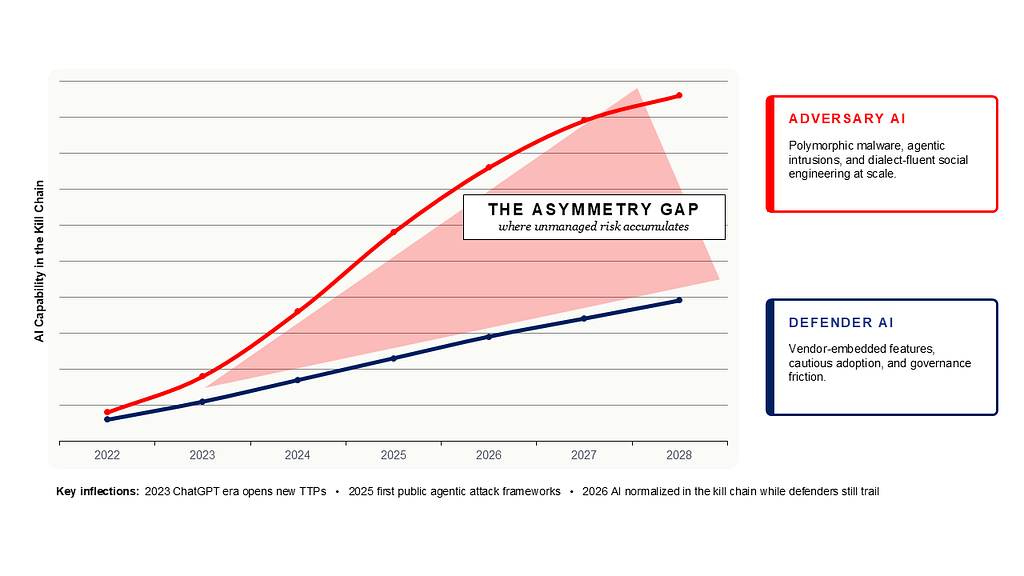 The AI Asymmetry Curve
How Adversaries Got Industrial-Scale AI Access
A common misconception inside enterprise SOCs is that threat actors use AI the same way analysts do: through a personal browser tab, with a personal account, hitting rate limits and trial expirations like everyone else. That model is years out of date.
Recent threat reporting describes a fully professionalized ecosystem for adversary LLM consumption. UNC6201, a PRC-nexus cluster, has been observed using publicly-hosted Python scripts that automate the entire premium-account lifecycle: registration, CAPTCHA bypass, SMS verification, account activation, then immediate cancellation before billing fires. The pipeline produces a continuous supply of disposable premium-tier accounts. UNC5673 goes further, running middleware projects like Claude-Relay-Service and CLI-Proxy-API that aggregate dozens or hundreds of separately-provisioned accounts behind a single OpenAI-compatible endpoint, with anti-detect browsers and rotated hardware fingerprints to defeat platform-side bot detection.
The category names tell the story:
- API gateways and aggregators that pool accounts into a unified endpoint and mask individual traffic patterns from safety monitoring.
- Account auto-registration tooling that solves CAPTCHAs and SMS verifications at scale to keep the disposable account pipeline running.
- Client interfaces like Cherry Studio and Kelivo that lower the technical bar for non-developer actors to drive complex multi-account workflows.
- Anti-detect browsers like Roxy Browser that isolate browser fingerprints and prevent platform bans from spreading across an actor’s account inventory.
The strategic point for SOC leaders is this: the adversary is not casually misusing a consumer ChatGPT account in violation of terms of service, the adversary is running a parallel, anonymized, redundant, abuse-resistant LLM consumption infrastructure that subsidizes itself through trial credits and account churn. They have built the production pipeline that your governance team has not yet approved for your own analysts, and that alone reframes the urgency conversation.
When AI Itself Becomes the Target
Here is where the threat picture turns inward, and where any SOC running AI workloads in production needs to pay attention. As organizations integrate LLMs deeper into their stacks (chatbots, code assistants, autonomous agents, vendor-embedded copilots), the orchestration layer around the model becomes the soft underbelly. The pattern reported across multiple investigations is consistent: frontier models themselves remain resilient to direct compromise, but the integration libraries, API connectors, skill plugins, and configuration files that surround them are not.
The benchmark incident is the March 2026 compromise associated with the cyber-crime group TeamPCP (tracked as UNC6780). The actor compromised popular GitHub repositories including the Trivy vulnerability scanner, Checkmarx, LiteLLM, and BerriAI through malicious pull requests and trojanized PyPI packages. The payload was a credential stealer called SANDCLOCK that extracted AWS keys and GitHub tokens from build environments, and those credentials were then handed to ransomware affiliates for monetization.
LiteLLM is the case study every SOC architect should sit with. It is an AI gateway utility used to integrate multiple LLM providers behind a single interface, exactly the kind of architectural pattern many enterprises are adopting and the kind of pattern this article will advocate for in a later section. A compromise of that gateway is not a typical software supply chain incident: it is potential exposure of every API secret routed through the gateway, every prompt logged, every response cached, plus an inbound foothold into whichever internal AI systems the gateway serves. An attacker with access to an organization’s AI infrastructure can use the organization’s own models against it: reconnaissance through internal Q&A bots, data exfiltration through summarization endpoints, lateral movement through agent skill integrations.
These risks map cleanly against Google’s Secure AI Framework (SAIF) taxonomy, with two patterns particularly relevant for SOC governance:
- Insecure Integrated Component (IIC) describes the risk of pulling in compromised external dependencies that undermine the trustworthiness of the AI system. Every package, every skill, every plugin in your AI stack is now a software supply chain exposure.
- Rogue Actions (RA) describes the risk of an AI system with elevated permissions being induced to execute unauthorized commands or exfiltrate credentials. An agent that can run shell commands or read files is a privileged identity in your environment, and it can be hijacked the same way any privileged identity can.
A parallel case study is the OpenClaw agent ecosystem. VirusTotal researchers documented in early 2026 that malicious “skills” had been published to the public skill marketplace, masquerading as legitimate plugins but carrying hidden routines to execute code and exfiltrate data from the host. The OpenClaw project responded by integrating automated VirusTotal code analysis into its skill marketplace, but the underlying lesson is broader: any AI agent platform that supports user-contributed skills, plugins, or tools is a software distribution platform, with all the supply chain risk that implies, plus the additional risk that the consumer of the skill is a model that can be prompt-injected by the skill itself.
For the SOC, three things change once you internalize this.
First, your AI workloads are now in scope for software composition analysis and supply chain monitoring on the same footing as any other production code: treat every pip install and every skill registration with the seriousness you treat npm dependencies in a customer-facing application.
Second, the blast radius of an AI gateway compromise is broader than a traditional service compromise, because the gateway typically holds the keys to every model the enterprise uses. Compromise of a single AI gateway in a mature enterprise is, plausibly, the largest single-point credential exposure in your environment.
Third, agentic AI components that can execute commands, read files, or call external APIs are privileged identities: they need to be onboarded, governed, audited, and decommissioned with the same rigor you apply to service accounts and human admins. The mistake is treating them like applications, when they behave like users with elevated privileges and lazy supervisors.
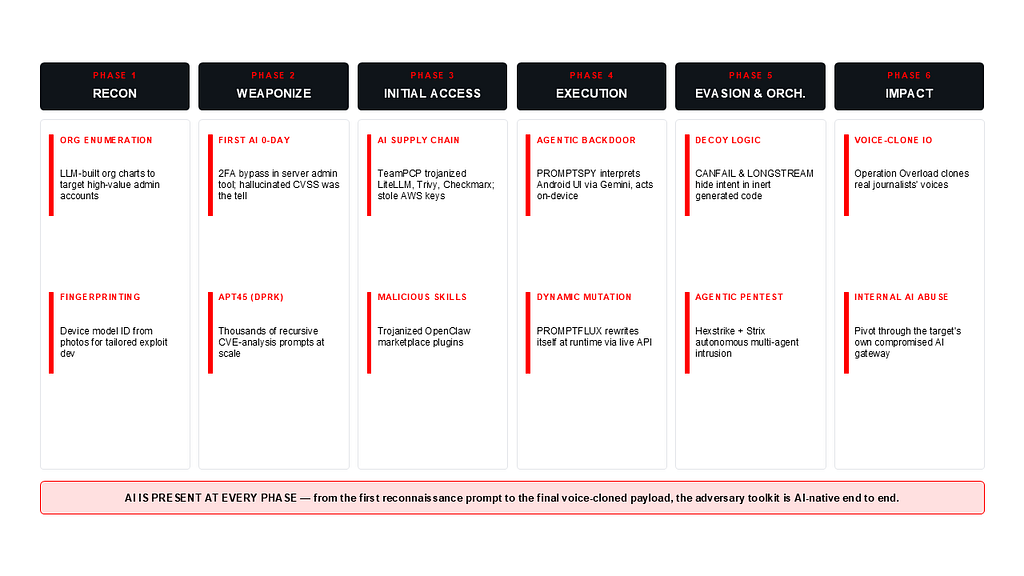 The AI-Augmented Attack Lifecycle
Why the SOC Is Stalling
If the threat case is so clear, why is the average enterprise SOC still hesitant? In conversations across MEA, EMEA, and beyond, the hesitation comes from five very real frictions: none of them are stupid, and all of them are solvable.
The Data Leakage Fear (It Is Real)
The most common informal AI usage pattern in SOCs today is the shadow AI workflow: an analyst pastes a suspicious PowerShell script, an alert payload, or a log snippet into a public ChatGPT or Claude session to ask “what is this doing?”
That is, in practical terms, a data exfiltration event by your own staff: customer identifiers, internal asset names, hostnames, usernames, sometimes credentials, all of it leaving the perimeter against terms-of-service the organization never signed.
The reflex response in many enterprises has been a blanket ban. The blanket ban does not work, because the analyst’s underlying need (“help me understand this thing fast”) is legitimate and the AI does help. So the usage continues, just in private browsers, on phones, off-network. You have not eliminated the risk, you have eliminated your visibility into it.
The Regulatory Fog
GDPR, the EU AI Act, sector-specific regulations across financial services, healthcare, critical infrastructure, and emerging national AI frameworks across the Gulf, Africa, and Asia have created a real compliance fog. SOCs handle some of the most sensitive data in the enterprise: incident artifacts, employee behavior, customer PII inside breach context. Legal teams are rightly cautious about routing that data through models whose training and retention practices may not be fully transparent.
The Vendor AI Trust Gap
Every security tool now claims AI inside it. Some of those claims are substantive: genuine ML for behavioral detection, genuine LLMs for alert summarization, genuine reasoning for triage. Some are marketing veneer over the same rules-and-regex that was there in 2019. SOC leaders, having been burned before, are skeptical, and that skepticism leaks into all AI initiatives, including the well-founded ones.
The TeamPCP / LiteLLM incident also lands here: vendor AI is not just a trust gap in capability terms, it is a trust gap in supply chain terms. The vendor’s AI feature is sitting on a stack of dependencies that the vendor may or may not have audited end-to-end, and the SOC inherits the consequences either way.
Confirmation Bias and the Articulate Machine
This one is the most dangerous and the least discussed. When an AI tool tells an L1 analyst “this alert is benign, false positive, close it,” there is overwhelming evidence from human factors research that the analyst will agree with the AI more often than they should. This is not a failure of training, it is a feature of how humans interact with confident, fluent, fast machines: we outsource our judgment to the most articulate voice in the room, and the AI will always be the most articulate voice in the room.
In a SOC, that bias has a name: a missed true positive that closes the door on a real intrusion for 47 days until the dwell time finally produces a noisy enough symptom.
Governance Debt
Most SOCs were architected before AI was a first-class citizen. Their RBAC models, their audit logging, their data retention policies, their change management: none of it accounts for “an LLM made an inference on this incident and that inference influenced a decision.” There is no audit trail for prompts, no version control for model behavior, no accountability surface when the AI is wrong. So leaders, prudently, slow down.
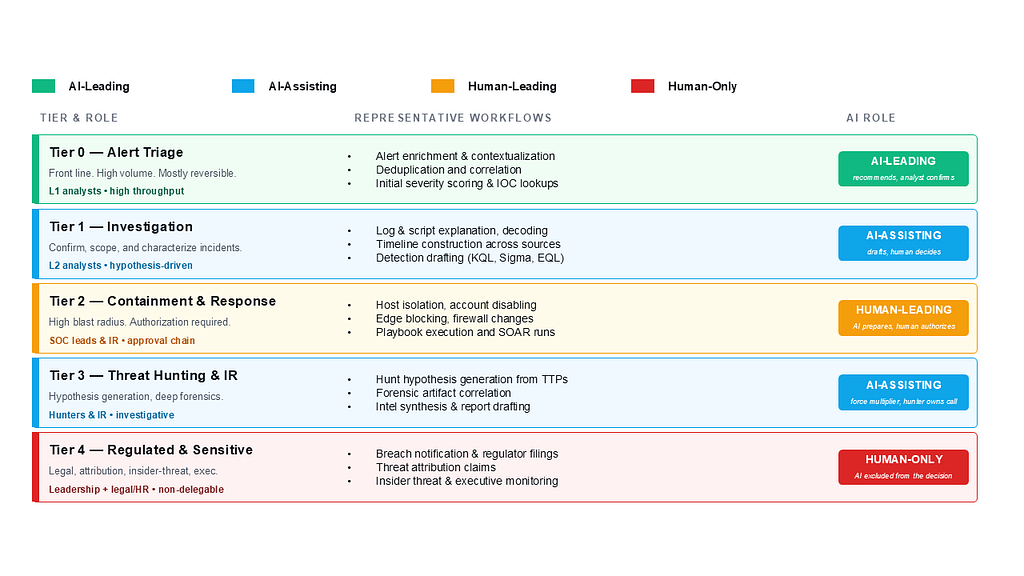 Where AI Lives and Where It Should Not in the SOC Operating Model
Defining the AI-Embedded SOC
A definition I have been refining across engagements:
An AI-Embedded SOC is one where AI is treated as a governed teammate: given a defined role, defined data access, defined decision authority, defined audit trail, and a defined supervisor. It is not a tool that anyone can summon at will, and not a magic layer that vendors apply on top of broken processes.
The key word is embedded: not bolted on, not overlaid, not “we bought a plugin.” Embedded means the operating model itself is redesigned so that humans and AI complement each other by design, with explicit handoffs.
Three principles anchor this model:
- AI assists in proportion to reversibility: the more reversible the action, the more autonomy the AI is granted, and the less reversible, the more human supervision is mandatory.
- AI is governed where it is consumed, not where it is produced: it does not matter if the model is from Anthropic, OpenAI, an open-weights deployment, or a vendor’s embedded service, the governance attaches to the workflow, not the vendor.
- AI does not replace the judgment loop, it compresses the discovery loop: the analyst still owns the decision, the AI shortens the path to the evidence behind the decision.
Where AI Earns Its Seat
These are the workflows where AI demonstrably improves outcomes today, and where the risk surface is manageable with reasonable guardrails.
Alert Enrichment and Contextualization
Given an alert, an AI agent can pull in IOC reputation, asset criticality, user role, recent activity, and prior similar alerts, and produce a structured pre-triage brief in seconds. This is enrichment, not adjudication: the analyst still decides, but the analyst is now reading a 200-word context summary instead of pivoting through six tools.
Risk profile: high value, low risk.
Log and Script Analysis
“Explain what this PowerShell does,” “summarize what happened on this host between 02:14 and 02:31,” “decode this base64 blob and tell me what it is”: AI is genuinely strong here, and the risk is bounded if the data stays inside a governed pipeline.
This is also where the threat intelligence on decoy logic becomes directly actionable. If you are using AI to summarize a suspicious script, ask the AI explicitly to flag inert or vestigial code segments, repetitive system queries, and functions that do not connect to the script’s apparent purpose: the same capability that adversaries use to insert filler can be turned around by defenders to spot it.
Risk profile: high value, medium risk.
Detection Content Generation
Drafting KQL, SPL, EQL, Sigma, or YARA from natural-language descriptions of an attacker behavior is a force multiplier for detection engineering. The risk is that AI-generated detections may have subtle correctness issues: wrong field names, broken time windows, missed edge cases. The mitigation is not to avoid AI here, it is to treat AI-generated detections like any other detection content: peer review, test in staging, validate with known-good and known-bad telemetry, then promote. The Use Case Development Lifecycle still applies, AI does not bypass it, AI accelerates it.
Risk profile: high value, medium-high risk.
Investigation Timeline Construction
Given a confirmed incident, AI can stitch together a coherent narrative across EDR telemetry, identity logs, network flow, and email gateway data, producing a draft timeline an investigator then refines. This is one of the highest-leverage uses, because timeline construction has historically eaten 40 to 60 percent of incident response hours.
Reporting and Executive Communication
Translating technical findings into executive-grade summaries, board-ready risk language, or CAB-ready change requests is something LLMs do well. Risk is low because the human reviews and approves before anything ships externally.
Threat Hunting Hypothesis Generation
“Given our environment and the latest TTPs published for this actor, what hunts should I prioritize this week?” An AI can generate ranked hypotheses, draft the queries, and rank by likely yield, and the hunter then runs them with full agency.
Public actor reporting also makes this concrete: if you know PRC-nexus actors are pairing Hexstrike with Graphiti memory graphs and Strix multi-agent frameworks, you can generate hunting queries for the network and endpoint signatures of those frameworks specifically. The same applies to PROMPTSPY’s outbound traffic to generativelanguage.googleapis.com and the gemini-2.5-flash-lite model from non-developer endpoints. AI helps defenders translate threat intel narrative into searchable telemetry at the speed the intel is published.
Where AI Must Not Lead
Equally important is naming the workflows where AI participation must be sharply constrained or eliminated.
Unilateral Incident Closure
An AI that auto-closes alerts without human review is, in operating-model terms, an unsupervised junior analyst with infinite confidence and no skin in the game. Whatever your suppression-rate metrics show, the missed-true-positive cost is asymmetric: a closed real incident is invisible until it is catastrophic. AI may recommend closure with reasoning, but a human must adjudicate.
Containment Actions on Production
Isolating a host, disabling a user, blocking an IP at the edge, killing a process on a domain controller: these are high-blast-radius actions. AI may prepare the action and present it, but a human with appropriate authority must authorize it. The exception is well-bounded auto-containment for clearly scoped scenarios such as a workstation with confirmed ransomware behavior on a non-critical segment, and even those exceptions need explicit pre-approval by leadership and a hard kill-switch.
Attribution Claims
AI is a confident pattern-matcher, attribution is a discipline that demands epistemic humility. Letting AI produce attribution language (“this is APT-X”) in customer-facing reports without senior analyst review is a reputational and legal liability waiting to happen. Public actor disclosures are useful precisely because they are backed by months of incident response data, abuse telemetry, and tradecraft correlation: a weekend chat session with a model is not that.
Regulatory and Legal Communications
Breach notifications, regulator submissions, law-enforcement-facing artifacts: the risk of model fabrication in a legally-binding document is unacceptable. AI may draft, counsel must own.
Decisions on Privileged Employee Data
Insider threat investigations, executive monitoring contexts, anything that touches HR, legal, or works-council jurisdictions in regulated geographies: pull AI back, the governance overhead exceeds the speed benefit.
Building Guardrails in Depth
If you remember one diagram from this piece, it should be this one. Most SOCs are trying to govern AI with a single control, usually an acceptable-use policy: that is the equivalent of perimeter-only security in 2026, which is to say, theatre. AI governance, like security itself, must be layered.
This model also pairs cleanly with the SAIF taxonomy: the Insecure Integrated Component (IIC) and Rogue Actions (RA) risk categories map directly to the data, model, and audit layers of the framework below. Where SAIF specifies the threat patterns, the five-layer model specifies the defensive controls.
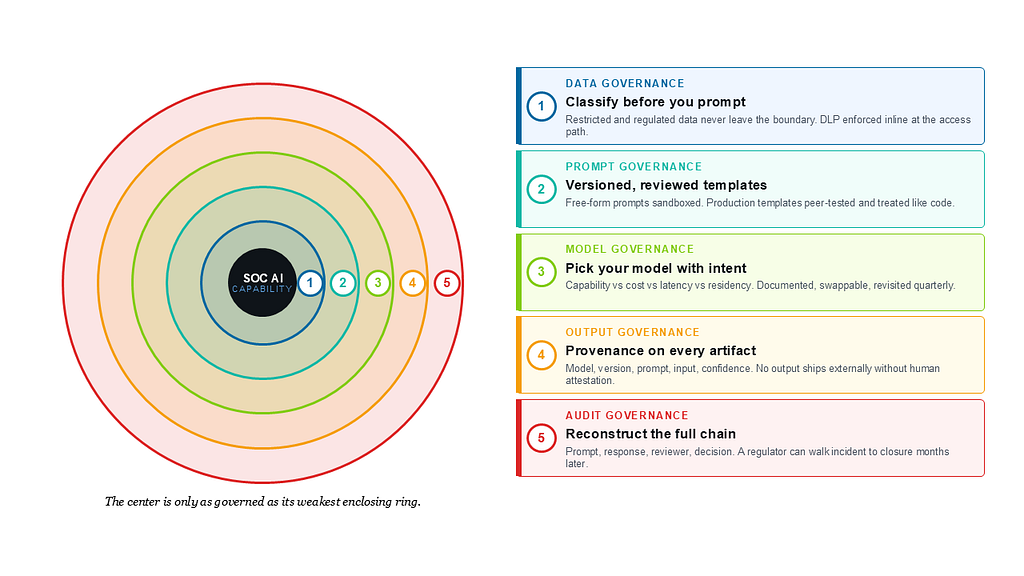 The Five-Layer AI Governance Model for SOCs
Layer 1. Data governance: classify before you prompt
No data crosses the boundary of an AI system without a classification check: public, internal, confidential, restricted, regulated. Restricted and regulated never leave the governed boundary. This is enforced not by policy alone but by DLP integrated into the AI access path: a proxy or gateway inspects every prompt, blocks on classification rules, and logs the attempt either way.
Layer 2. Prompt governance: structured, reviewed, versioned
Free-text prompting at scale is an audit nightmare. Production AI workflows in the SOC should use prompt templates that are versioned, reviewed, peer-tested, with parameterized inputs. Analysts can still ask freeform questions for exploration, but those queries are tagged differently and routed to a sandboxed pathway that does not touch production data. Templates that go to production are reviewed like code.
Worth noting here: the same persona-prompting techniques that adversaries use to jailbreak public models (UNC2814’s “senior security auditor” and “C/C++ binary security expert” personas, for example) can manifest inside your own enterprise AI stack if your prompt governance is loose. A user, or a compromised integration, asking your internal model to “act as a penetration tester with full authorization to enumerate this network” should hit a policy block, not a prompt success.
Layer 3. Model governance: pick your model with intent
Not every workflow needs the most capable model. A small, locally-deployed model is fine for log summarization on commodity volumes, and a frontier model with strong reasoning is justified for incident timeline construction. Model selection is a deliberate trade-off across capability, cost, latency, data residency, and trust posture: document the choice, revisit it quarterly.
For organizations with strict data residency requirements, and there are many in MEA, EU, and APAC, this layer may mean self-hosted inference for sensitive workflows, vendor-hosted for less sensitive, and a clear policy on which is which.
This is also the layer where your software composition analysis lives for AI workloads: every model, every gateway library, every connector, every skill package is a dependency. The TeamPCP / LiteLLM incident is a reminder that the supply chain of your AI stack is now part of your AI risk posture.
Layer 4. Output governance: never trust raw AI output as ground truth
Every AI-generated artifact that influences a decision must carry provenance metadata: which model, which version, which prompt template, which input data, which timestamp, which confidence. Outputs are tagged in the case management system as AI-generated until a human reviewer signs off. No AI output reaches a customer, regulator, or executive without human attestation.
Layer 5. Audit governance: log the prompts, log the outputs, log the decisions
If a regulator asks you, six months from now, “on what basis did your SOC close incident #4471?”, you must be able to produce the full chain: the prompt, the AI’s response, the analyst who reviewed it, the additional evidence they gathered, the decision they made, and why. AI in the SOC without a prompt-and-response audit trail is unauditable, and unauditable means uninsurable, indefensible, and ungovernable.
From Shadow AI to a Governed Path
Now to the question that keeps SOC managers awake: “My analysts are using ChatGPT and Claude on their personal accounts to do their jobs, what do I do?”
Three things, in this order.
Stop Pretending the Ban Works
An outright ban without an alternative is not a control, it is a prayer. Analysts will continue to use AI, and you will simply lose visibility, lose audit, and lose the ability to teach safer patterns. The threat model assumes good-faith employees taking shortcuts, not malicious insiders, but the data leakage is real either way.
Provide a Sanctioned Alternative
Offer your analysts a sanctioned AI workspace. Options range from enterprise tier subscriptions to frontier providers (with the appropriate data processing agreements and zero-retention configurations), to private cloud deployments, to fully self-hosted open-weights models. The right answer depends on data sensitivity, regulatory geography, and budget, but any sanctioned, monitored, contractually-bound AI access beats unsanctioned shadow usage every single time.
The sanctioned alternative must be:
- Easier to use than the shadow path: if the analyst has to fill in a form to get to it, they will not use it.
- Demonstrably safe: communicate clearly what data is logged, what is retained, and what is not.
- Productive: pre-loaded with SOC-relevant prompt templates, integrated into the case management system, and tied to the analyst’s identity for accountability.
Build the SOC AI Gateway
For mature programs, the answer is a SOC AI gateway: a single internal access path through which all AI requests flow, regardless of underlying model provider. The gateway handles authentication, applies DLP, enforces classification policy, manages prompt templates, logs everything, and brokers between multiple model backends. This is the architectural pattern that lets you switch model providers without disrupting analysts, comply with shifting regulations without rebuilding workflows, and present auditors with one place to look instead of fifteen.
A critical caveat from the TeamPCP / LiteLLM case study: the gateway you build is itself a high-value target. It centralizes API keys for every model you use, and it sits in the path of every sensitive prompt and every sensitive response. Treat it like a tier-0 asset: sign your dependencies, pin your versions, monitor outbound traffic from the gateway to anomalous destinations, audit changes to the gateway code path with the same rigor as your authentication broker.
The benefit of the gateway pattern outweighs the risk, but only if the gateway itself is held to the same security standard you hold the rest of your privileged identity infrastructure.
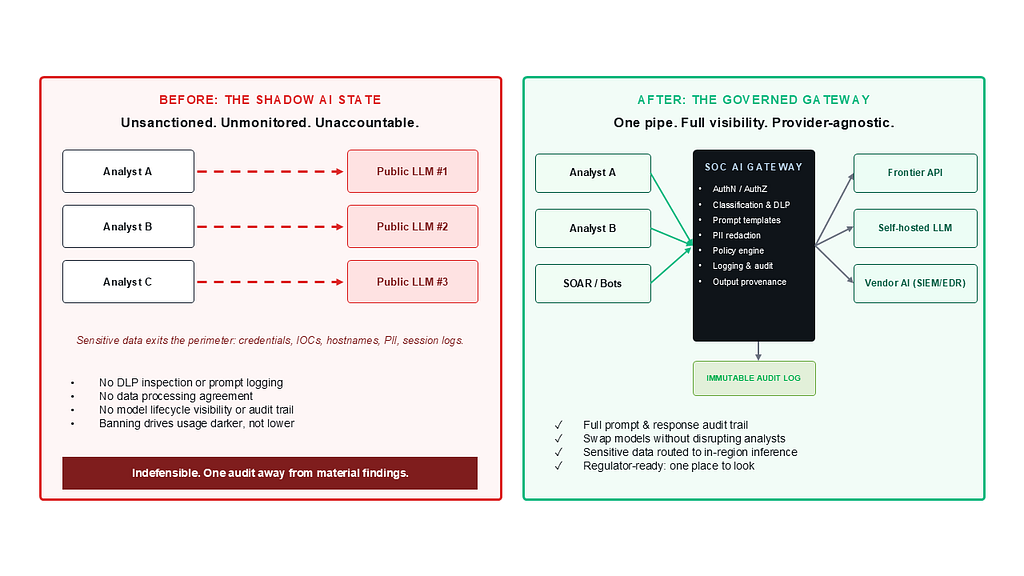 From Shadow AI to Governed AI Gateway
The Failure Mode Nobody Reports
This deserves its own section because it is, in my experience, the single most under-managed risk in AI-embedded SOCs.
When AI tells you what you wanted to hear, you will believe it. When AI tells you something is “likely benign,” your brain will helpfully assemble the reasons it is benign, and you will find them, because they are almost always findable. This is how an L1 analyst, on hour seven of a twelve-hour shift, with 280 alerts in queue, ends up agreeing with an AI summary that says “PowerShell encoded command, likely admin script, no further action,” and clicks close.
The defense is structural, not motivational. You cannot train this bias away, because it is not a knowledge gap, it is a cognitive default. The structural defenses that work:
- Disagreement quotas: track, per analyst, the rate at which they override AI recommendations. A 0 percent override rate is a red flag, not a gold star. Calibrate against ground truth from later-confirmed incidents.
- Adversarial second opinions: for high-stakes alert categories, run two AI passes with different prompts (or different models) and surface disagreements, forcing the human to break the tie.
- Mandatory evidence presentation: require the AI to show its work. Not just “this is benign,” but “this is benign because: (1) the parent process is X, (2) the user has executed similar scripts Y times in the past 30 days, (3) the destination is on the allowlist.” Now the analyst has something to interrogate.
- Periodic ground-truth recalibration: sample closed alerts, re-investigate with fresh eyes and full context, measure the AI’s actual precision (not its claimed confidence), and publish the results internally.
The goal is not to make the analyst doubt the AI in every case, the goal is to make doubting the AI a normal, frictionless, professionally rewarded part of the job.
The Post-AI Review Loop
A discipline that mature AI-embedded SOCs adopt and immature ones skip is the Post-AI Review Loop: a structured habit of going back to AI-influenced decisions and re-evaluating them with the benefit of hindsight.
It works in three cadences.
Per-Incident Review, Within 48 Hours
For every Sev-1 and Sev-2 incident, the post-incident review explicitly asks: where did AI inform a decision, was the AI correct, if it had been wrong what was the human safety net, and did the safety net function?
Monthly Content Review
Every detection rule, response playbook, or triage prompt that AI generated or significantly influenced is re-reviewed monthly against fresh telemetry. Threat landscape drift is real, and AI-generated content has the same drift, often faster. With state-actor groups iterating on their tradecraft as fast as researchers can document them, a rule written in January is not the same rule in May.
Quarterly Model Review
Every model in production is re-evaluated against held-out evaluation sets: performance degradation is measured, drift, hallucination rates, and prompt-injection susceptibility are tested, and models that have degraded are replaced or retrained. A model in production that has not been re-evaluated in six months is technical debt with a confidence interval.
Metrics That Actually Matter
If you cannot measure it, you cannot govern it. The metrics that distinguish a real AI-embedded SOC from a marketing-deck SOC are these.
Operational metrics
- Mean time to triage (MTTT), before and after AI assistance, by alert category
- Mean time to investigate (MTTI), including AI-assisted timeline construction
- AI-recommendation acceptance rate, and override rate, broken down by analyst tenure
- AI-to-human handoff latency, how quickly an analyst engages after AI surfaces something
Quality metrics
- AI-influenced false negative rate, the most important number nobody tracks
- AI hallucination incident count, caught and uncaught
- Detection content correctness rate (AI-drafted vs human-drafted), measured in staging before production
Governance metrics
- Shadow AI usage rate, estimated via DLP and network telemetry (yes, you should be measuring this)
- Sanctioned AI gateway utilization
- Prompt audit completeness, the percentage of AI-influenced decisions with full prompt-and-response trails
- Regulatory-readiness score, internal audit pass rate against your AI control framework
Supply chain metrics
- AI-dependency inventory coverage, the percentage of LLM-touching components under software composition analysis
- AI gateway anomaly detection rate, baseline-vs-current outbound traffic patterns from the gateway
- Skill and plugin provenance verification rate, the percentage of installed AI skills with cryptographic signature and reproducible build
A SOC that cannot produce these numbers is not governing AI, it is using AI and hoping.
A 12-Month Implementation Path
For SOC leaders staring at this and wondering where to start, here is a sequenced 12-month path that has worked across multiple engagements.
Months 1 to 2. Foundation
- Inventory current AI usage, sanctioned and shadow
- Draft the AI Acceptable Use Policy specific to the SOC
- Stand up a sanctioned AI access path with DLP and logging
- Classify SOC data assets against AI exposure rules
- Inventory AI dependencies in your existing stack (gateways, libraries, embedded vendor features)
Months 3 to 4. Pilot
- Pick two high-value, low-risk workflows: alert enrichment and log explanation
- Build prompt templates, integrate with case management, train analysts
- Measure baseline and post-AI metrics
- Begin software composition analysis on AI-adjacent packages
Months 5 to 6. Expand
- Add detection content drafting and incident timeline construction
- Stand up the Post-AI Review Loop, per-incident and monthly
- Begin tracking confirmation bias indicators: override rates and disagreement quotas
- Establish supply chain monitoring for AI gateway and integration libraries
Months 7 to 9. Govern at scale
- Build the SOC AI gateway architecture, with tier-0 protection posture
- Establish the five-layer governance model formally
- Engage internal audit and external regulators with the model proactively
- Adopt SAIF (or equivalent) as the formal AI risk taxonomy for your environment
Months 10 to 12. Mature
- Quarterly model evaluations institutionalized
- Selective autonomy expanded to bounded auto-containment scenarios
- AI-embedded operating model published as the official SOC reference architecture
- Continuous threat intel ingestion for AI-augmented adversary TTPs
This is not a tooling project, it is an operating model transformation: treat it as such.
For Vendors & For Clients.
To vendors: Stop selling AI as a feature, start selling AI as a governed capability. The SOCs ahead of the curve are not asking “does it have AI?”, they are asking “what is the data flow, what is the audit trail, what is your model lifecycle, what happens to my prompts, what is your hallucination rate on my data, what dependencies sit between your model and my data, and what evidence can you give me that your AI behaves consistently?” If your sales engineers cannot answer these questions, you are selling 2023 product into a 2026 buyer. The TeamPCP incident put every vendor on notice that the AI dependency stack is now an active battleground, and treating it as a marketing surface rather than a security surface is no longer credible.
To Clients: The question is not “is this vendor’s AI good?”, the question is “does this vendor’s AI fit inside my governance model, and is the vendor’s supply chain hygiene good enough that I would trust it with my keys?” A less capable AI inside a sound governance frame will outperform a more capable AI that fights your governance every day. Buy for fit, not for marketing.
The Honest Posture
The SOC of 2026 cannot afford AI maximalism (turning every workflow over to autonomous agents and hoping), and it cannot afford AI minimalism either (pretending the threat side is not racing ahead and the defender side can stay on yesterday’s playbook).
The LiteLLM compromise, the PROMPTSPY agent loops, the APT45 industrial prompting, the Operation Overload voice clones, the wooyun-legacy skill plugins, the first AI-developed zero-day: these are not isolated curiosities, they are the same story told from six different angles. The story is that adversaries have moved AI from “tool to experiment with” to “tool to industrialize,” and defenders who treat AI as a tool to experiment with are no longer matching the threat model.
The honest posture is a third position, and it is the harder one: AI is a teammate, not a tool. Onboard it deliberately, give it a defined role, supervise it in proportion to consequence, audit it relentlessly, replace it without ceremony when it stops earning its seat, and never, ever let its fluency substitute for your judgment.
The asymmetry is real, closing it is not optional, but the way we close it determines whether we end up with a SOC that is faster, sharper, and more defensible, or one that has industrialized its own confirmation bias at machine speed.
Build the operating model first, embed the AI second, govern from day one.
The AI-Embedded SOC: An Operating Model for the Asymmetry Era was originally published in Detect FYI on Medium, where people are continuing the conversation by highlighting and responding to this story.
Introduction to Malware Binary Triage (IMBT) Course
Looking to level up your skills? Get 10% off using coupon code: MWNEWS10 for any flavor.
Enroll Now and Save 10%: Coupon Code MWNEWS10
Note: Affiliate link – your enrollment helps support this platform at no extra cost to you.
Article Link: https://detect.fyi/the-ai-embedded-soc-an-operating-model-for-the-asymmetry-era-520778c4ad12?source=rss----d5fd8f494f6a---4
1 post - 1 participant
Malware Analysis, News and Indicators - Latest topics

Sp123
"An underestimated security threat to organizations is employee apathy and burn out."
