Measuring Threat Detection Accuracy
The Purpose of Threat Detection
The purpose of threat detection is simple: correctly identify malicious activity as malicious, and correctly identify benign activity as benign. In other words, call true positives as true positives and true negatives as true negatives. Everything else exists to support that goal.
This matters because incident response teams operate on the output of detection systems. Every alert consumes investigation time, operational bandwidth, and human attention. Poor detections either waste responder cycles through false positives or create blind spots through false negatives.
A missed detection is not a total system failure
The good part of being a defender is they need to catch the attacker once in the kill chain to initiate containment, investigation, or remediation. It is important to acknowledge that threat detection is not about achieving perfect visibility on every attacker action. In real environments, that is unrealistic. Attackers generate sequences of actions, not isolated events.
Missing one signal is not automatically a system failure if another detection earlier or later in the attack chain succeeds. Its a failure of that detection and should be treated as such.
Detections and the kill chain
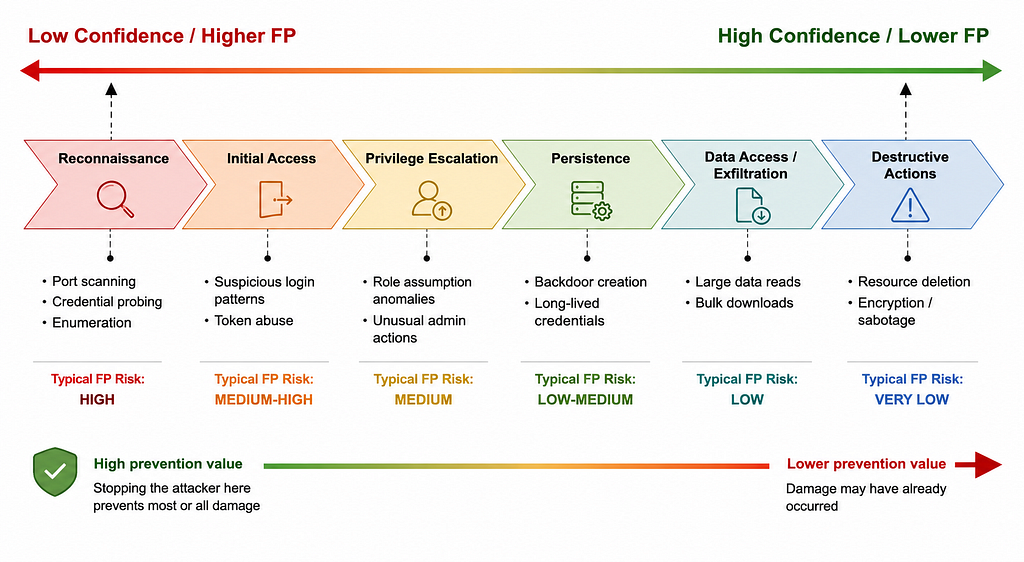
Earlier Detections Are More Valuable
Detection accuracy cannot be evaluated independently from where the detection operates in the kill chain. Two detections with identical false positive and false negative rates may provide completely different operational value depending on where they reside in the kill chain.
Earlier-stage detections are significantly more valuable because they create an opportunity to stop the attacker before meaningful damage occurs. The challenge is that early attacker behavior often resembles legitimate activity. Reconnaissance, credential probing, or low-volume privilege exploration can overlap heavily with normal user behavior.
A detection that operates early in the kill chain while maintaining a very low false positive rate is therefore extremely valuable to a security program. It allows incident response teams to engage earlier without overwhelming them with noise.
Later-stage Detections Are More Accurate
Later-stage detections are often easier to make accurate because attacker behavior becomes much more explicit. Large-scale data access, destructive actions, persistence mechanisms, or privilege escalation attempts are usually much stronger signals than early reconnaissance activity.
These detections are often strong enough to justify immediate high-severity engagement from incident response teams. The downside is that by the time these alerts fire, the attacker may already have established persistence or caused operational impact.
This creates an important asymmetry in detection engineering. Earlier detections maximize prevention potential while later detections maximize confidence. Accuracy alone is not enough. The timing of the detection matters just as much.
Measuring Threat Detection Accuracy
Proactive Measurement
Threat detection accuracy can generally be measured using proactive and reactive techniques. Proactive measurement is controlled validation performed by the detection engineering team itself.
This includes unit tests, replaying known attack telemetry, simulated attack sequences, and curated test cases for specific detections. The advantage of proactive measurement is repeatability. Teams can continuously validate whether detections still behave correctly as infrastructure, schemas, and logging pipelines evolve.
Detecting Silent Regressions
Detections often fail silently. A logging schema may change, a parser may break, or upstream telemetry may stop flowing correctly while the detection itself appears healthy.
Proactive testing helps identify these regressions before real attackers expose them. Without continuous validation, organizations can develop a false sense of confidence where detections appear operational but are no longer producing meaningful coverage.
Reactive Measurement
Reactive measurement comes from observing real-world attacker behavior. This includes red team exercises, bug bounty activity, and actual security incidents.
Reactive measurement is often more valuable because it tests detections against realistic attack paths instead of controlled assumptions. Real attackers do not behave like curated test cases. They chain techniques together, adapt to environments, and exploit edge cases that detection engineers may not have anticipated.
Both Measurement Styles Are Necessary
A mature detection program requires both approaches. Proactive testing validates expected behavior under controlled conditions. Reactive measurement validates whether detections actually work against real attacker behavior in production environments.
Organizations that rely only on proactive testing often overestimate their coverage. Organizations that rely only on reactive measurement usually discover gaps too late.
Debugging False Negatives
False negatives are one of the most important feedback loops in detection engineering. A false negative occurs when malicious activity happens but no meaningful detection is generated.
Debugging false negatives is not just about improving detection quality. It is also about improving visibility into the limitations of the overall security telemetry pipeline.
Incomplete or Missing Telemetry
Not all false negatives are caused by bad detection logic. In many cases, the detection itself may have been correct, but the underlying telemetry was incomplete or missing.
If the required audit logs, API events, process telemetry, or network signals were never collected, the detection system never had a chance to succeed. These failures are fundamentally data quality problems rather than detection engineering problems.
Missing Detection Coverage
Another common failure mode is missing detection coverage entirely. The telemetry existed, but nobody had written logic to identify that specific attacker behavior yet.
This is a straightforward coverage gap. These types of false negatives are often the easiest to remediate because the missing behavior can usually be converted into a new detection once identified.
Incorrect Detection Logic
The third category is when the data exists and the detection exists, but the detection logic itself is flawed.
Thresholds may be too strict, assumptions may not generalize across environments, or the logic may have been written around an overly narrow interpretation of attacker behavior. These failures are often the hardest to identify because the detection appears functional until a real-world scenario exposes the weakness.
Operationally Invisible Detections
There are also situations where the detection technically fires, but the signal is buried under excessive noise and never reaches responders in a meaningful way.
Operationally, this behaves almost identically to a false negative. A detection that cannot be actioned consistently is not providing real defensive value regardless of whether the underlying logic technically executed correctly.
False Negatives Should Be Categorized Separately
Treating all false negatives as a single problem usually leads to poor remediation strategies. Data quality issues, coverage gaps, logic flaws, and operational noise require completely different fixes.
Detection engineering becomes significantly more effective when teams separate these categories and debug them independently.
Measuring Threat Detection Accuracy was originally published in Detect FYI on Medium, where people are continuing the conversation by highlighting and responding to this story.
Introduction to Malware Binary Triage (IMBT) Course
Looking to level up your skills? Get 10% off using coupon code: MWNEWS10 for any flavor.
Enroll Now and Save 10%: Coupon Code MWNEWS10
Note: Affiliate link – your enrollment helps support this platform at no extra cost to you.
Article Link: https://detect.fyi/measuring-threat-detection-accuracy-6724732ea150?source=rss----d5fd8f494f6a---4
1 post - 1 participant
Malware Analysis, News and Indicators - Latest topics

Sp123
"An underestimated security threat to organizations is employee apathy and burn out."
